
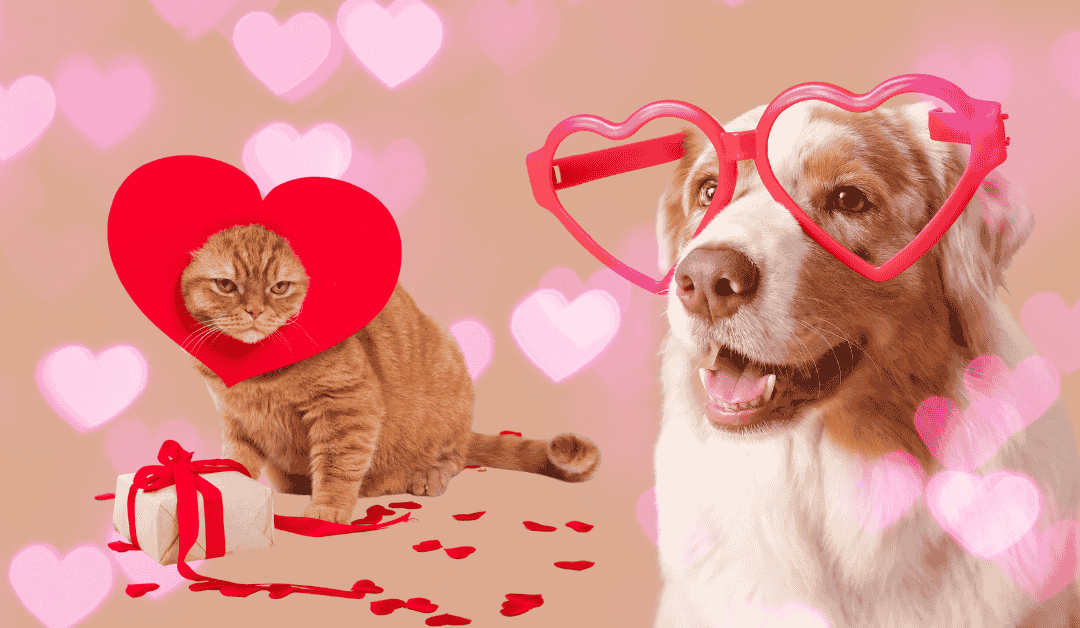
Valentine’s Day tends to spotlight one big question in pet households: Do pets feel love? While we may not be able to ask them directly, research in animal behavior tells us that dogs and cats experience a range of emotions, some surprisingly similar to our own. Let’s take a closer look at a few that feel especially fitting as we near Valentine’s Day weekend.
 Do Pets Feel Love?
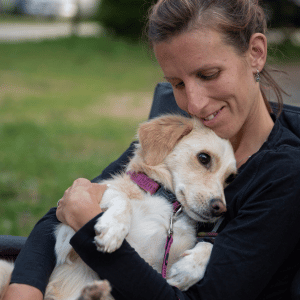
In dogs, bonding is closely tied to oxytocin, the same hormone associated with attachment in humans. Studies have shown that when dogs and their people make eye contact, both experience increases in oxytocin levels. That mutual gaze, tail wag, or full-body lean isn’t random; it’s attachment in action.
Cats express affection differently, but just as meaningfully. Slow blinks, head bunting, kneading, and choosing to sit near (or on) you are signs of trust and connection.
Love in pets may not look like it does in human romance, but attachment and social bonding are very real!
 Do Pets Feel Jealousy?
Ever notice your dog wedging themselves between you and another pet, or even your phone?! Research suggests dogs can display behaviors consistent with jealousy when they perceive attention shifting away from them. It’s not petty; it’s social competition for something of value: you and your attention. If you have two dogs that (literally or figuratively) fight over you, it’s resource guarding, and, often, you are the resource. If it escalates beyond just a little pushing, it needs to be addressed with the help of a dog trainer.
Cats can also show jealousy (aka tension) in multi-pet households, especially if routines or attention patterns change. What may look like jealousy is often a response to perceived instability or resource guarding. As both predator and prey, cats are sensitive to their survival. They feel comforted when their resources are stable, which is why introducing new cats to the household is tricky and often requires the help of a cat behavior expert to ensure it goes smoothly.
 Do Pets Feel Butterflies in their Stomachs?
You know that excited, wiggly, can’t-contain-themselves energy when you grab the leash or rattle the front door lock? That’s anticipation, and yes, pets experience it. Dogs in particular are highly attuned to cues that predict positive events. Elevated heart rates, pacing, whining, or spinning in circles can all signal that rush of excitement.
Cats show anticipation in subtler ways: gathering near the door before feeding time, vocalizing when they hear a can open, or appearing at their usual window or perch when they expect you home.
Do Pets Miss Us?
One of the clearest emotional experiences pets demonstrate is attachment-based distress. Dogs may show signs of separation anxiety, with signs like vocalizing, pacing, and destructive behavior when their person or persons are gone. Even dogs without clinical anxiety can appear subdued or extra enthusiastic upon reunion, meaning they are relieved to see you back because they enjoy your presence and having you near them.
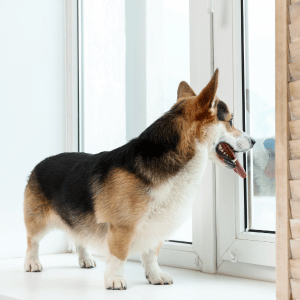 Cats, though often labeled as independent, can also miss their people greatly. Changes in appetite, increased hiding, or altered behavior when routines shift suggest they notice absence more than many assume. We see this when caring for cats; many skip a meal or two at first, worried about their humans, but eventually accept the change in routine and resume life as usual until you get back.
Pets with true separation anxiety feel more than just “missing” their humans; they need the help of a veterinarian, sometimes pharmaceuticals, and often desensitization training, to ensure their wellbeing when their families are away.
Pets Feel Love Year-Round
Emotions in pets aren’t identical to human emotions, but they are complex and meaningful. Dogs and cats form attachments, anticipate positive experiences, respond to social changes, and feel distress when bonds are disrupted.
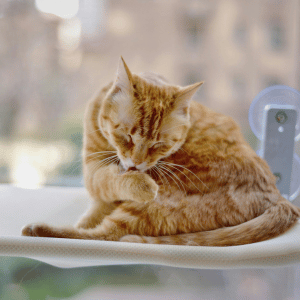 This Valentine’s Day, it’s worth remembering that love for our pets isn’t one-sided. The routines we keep, the walks we take, the enrichment we provide, and the calm presence we offer all strengthen that bond. And, our pets don’t need a day on the calendar to celebrate love; they feel strongly about us and our presence every day of the year!
At PCPSI, we see the tail wag at the door, the cat who emerges from hiding when trust is built, the visible relief when routines stay consistent. Love, in the animal world, often looks like security and familiarity. And, we love to form bonds with your pets, enjoying the love they share with us. After all, cat and dog hearts are full of love to give, and they usually give it freely! And that may be the most meaningful kind of Valentine’s connection there is.
The Best Dog Walkers & Cat Sitters in Dallas
We are accepting new clients in the Dallas Metroplex. To learn more about our pet services, please visit our FAQs and contact us at 214-828-0192 and pets@pcpsi.com. Alternatively, you can register via our client portal, available here. Existing clients, please submit reservations via this link.
We proudly serve cats in the following Dallas neighborhoods & surrounding suburbs: Bluffview, Deep Ellum, Downtown, Highland Park, Knox Henderson, Lake Highlands, Lakewood, Lower Greenville, Medical District, North Dallas, Oak Lawn, Northwest Dallas, Northeast Dallas, Old East Dallas, Preston Hollow, Turtle Creek, University Park, Victory Park.
If you are outside of our service area, check the National Association of Professional Pet Sitters (NAPPS) or Pet Sitters International (PSI) to find a pet sitter near you.